FCC Rules, Orders, and Robotext Controls
FCC actions addressing consent revocation, opt-out handling, robotext blocking, and related operational controls.
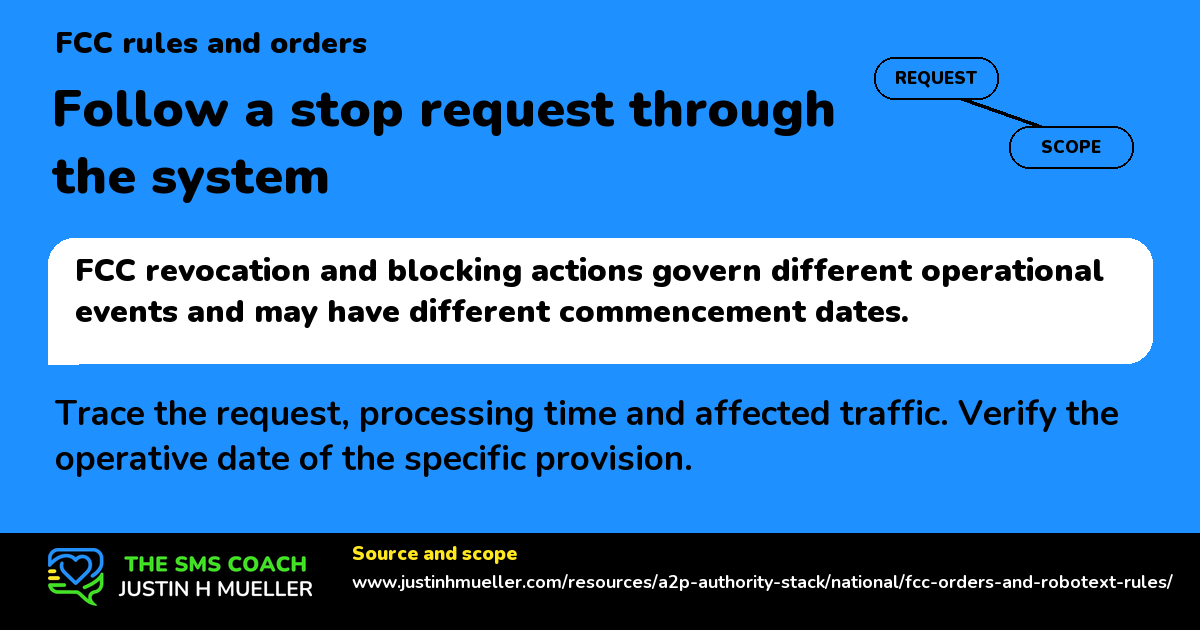
Follow a stop request through the system
FCC revocation and blocking actions govern different operational events and may have different commencement dates.
What to check. Trace the request, processing time and affected traffic. Verify the operative date of the specific provision.
What this authority layer covers
FCC actions addressing consent revocation, opt-out handling, robotext blocking, and related operational controls.
Authorities and official sources
Each entry explains what the source says, where its limits are, and what it does not establish.
How source verification and review dates are documented
Agency order · Partially active
2024 rules and 2026 amendments
Release evidence review · 2026-11-19
The November 25, 2026 effective date was verified against 91 FR 67214. Earlier rules and the final amendments have distinct operative periods.
Historical source and review record
Recorded source support: Supported. Historical verification disposition: Verified. Current substantive review: Reviewed for the stated claim and qualification. Recorded review date: 2026-11-19.
The November 25, 2026 effective date was verified against 91 FR 67214. Earlier rules and the final amendments have distinct operative periods.
How this authority relates to messaging
Program applicability depends on the activities, jurisdiction, and conditions covered by this source. Use the scope and limitations below to assess the fit.
What the source establishes
- The FCC’s 2024 revocation rules recognize reasonable requests and require covered requests to be honored within a reasonable time, no longer than ten business days. FCC 26-67 modifies the treatment of informational categories, designated opt-out methods and financial-institution alerts. The Federal Register specifies November 25, 2026 as the effective date of the 2026 amendments.
Limits and important context
- FCC 26-67 ¶¶ 10–24 narrows informational revocation to the relevant category, preserves revocation across the caller’s marketing, and will permit clearly disclosed exclusive opt-out methods. A sender designating a text keyword must still recognize all seven standard keywords. Until the amendments take effect, the existing reasonable-method rule and prohibition on specifying an exclusive method continue.
- DA 26-12 addressed the cross-category informational-revocation requirement. The FCC explains that the 2026 amendments supersede that waiver when they take effect. Apply the rules in force on the date of the request.
- A permitted one-time confirmation must contain no marketing. The five-minute presumption and ten-business-day ceiling are distinct rules. The adopted amendment in FCC26-67 paragraph20 would, when effective, modify the limited financial-institution fraud-alert exemption's provided-number condition; its specified reliable-source alternatives do not apply to every business or every source.
- The companion Further Notice, ¶¶ 29–35, seeks comment on matters including a shorter revocation deadline, two-way texting, broader opt-outs and affiliates. Those proposals are not adopted obligations.
Official and supporting sources
- 91 FR 67214–67219, October 26, 2026, DATES and final amendments to 47 CFR 64.1200 Source retrieved through a second public access path.
- FCC 24-24, consent revocation and one-time confirmation provisions Document matches the retained source capture.
- FCC 26-67 cover; ¶¶ 10–24 and 29–35; Appendix A Document matches the retained source capture.
- DA 26-12, released January 6, 2026; ¶¶ 1, 9–13 Document matches the retained source capture.
- 47 CFR § 64.1200(a)(10)–(12), historical eCFR text through October 15, 2026 Document matches the retained source capture.
- Official publication-index query for FCC26-67 through October19,2026:count0; absence in this query is not an invented effective date Source retrieved for this release.
Source details
- Recorded source support
- Supported
- Historical verification disposition
- Verified
- Current substantive review
- Reviewed for the stated claim and qualification
- Recorded review date
- 2026-11-19
- Jurisdiction
- United States federal
- Source type
- Agency order
- Recorded operative status
- Partially active
Agency order · Current
FCC robotext and illegal-text blocking rules
Release evidence review · 2026-11-19
Release review compared the published summary and limits with retained evidence. All cited destinations supplied source text.
Historical source and review record
Recorded source support: Supported. Historical verification disposition: Verified. Current substantive review: Pending; citation pinpoints checked. Recorded review date: 2026-10-19.
Passage locator: 47 CFR64.1200(p),(r),(s); FCC23-21 and23-107; IMC disposition. Historical source_claims, original classifications and legacy final_disposition remain historical. Review date applies to the revised bounded summary, not an exhaustive jurisdiction survey or every routing combination. Agency guidance is identified as guidance. Absence of an explicit texting clause is not evidence that no law applies.
How this authority relates to messaging
Program applicability depends on the activities, jurisdiction, and conditions covered by this source. Use the scope and limitations below to assess the fit.
What the source establishes
- FCC robotext rules require mobile providers to block texts from a reasonable do-not-originate list and require a remedy contact for documented erroneous blocking.
Limits and important context
- The list covers specified subscriber-designated, invalid, unallocated and unused numbers. Section 64.1200(s) separately requires terminating providers to respond to Enforcement Bureau notices of illegal texts, including required number blocking and reassignment procedures.
- The consent restrictions in FCC 23-107 Part III.D were vacated in IMC; that disposition must not be generalized to all robotext-blocking provisions. These are provider duties and do not guarantee delivery of registered traffic.
Official and supporting sources
- FCC 23-21, provider blocking of texts from invalid, unallocated, or unused numbers Document matches the retained source capture.
- FCC 23-107, additional robotext blocking and consent controls Document matches the retained source capture.
- Text blocking, error contact and illegal-text notifications Document matches the retained source capture.
- No. 24-10277 (11th Cir. Jan. 24, 2025) Document matches the retained source capture.
Source details
- Recorded source support
- Supported
- Historical verification disposition
- Verified
- Current substantive review
- Pending; citation pinpoints checked
- Recorded review date
- 2026-10-19
- Jurisdiction
- United States federal
- Source type
- Agency order
- Recorded operative status
- Current
Continue with the most useful next step
Move from a jurisdiction or authority layer to the sources and tools most likely to answer the next question.
A2P Compliance Audit
Explore a scoped review of consent, disclosures, registration, and governance.