Michigan SMS Marketing and A2P Messaging Rules
Recorded calls and caller identification. If the subscriber requests a callback number, provide one answered by a person during solicitation hours.
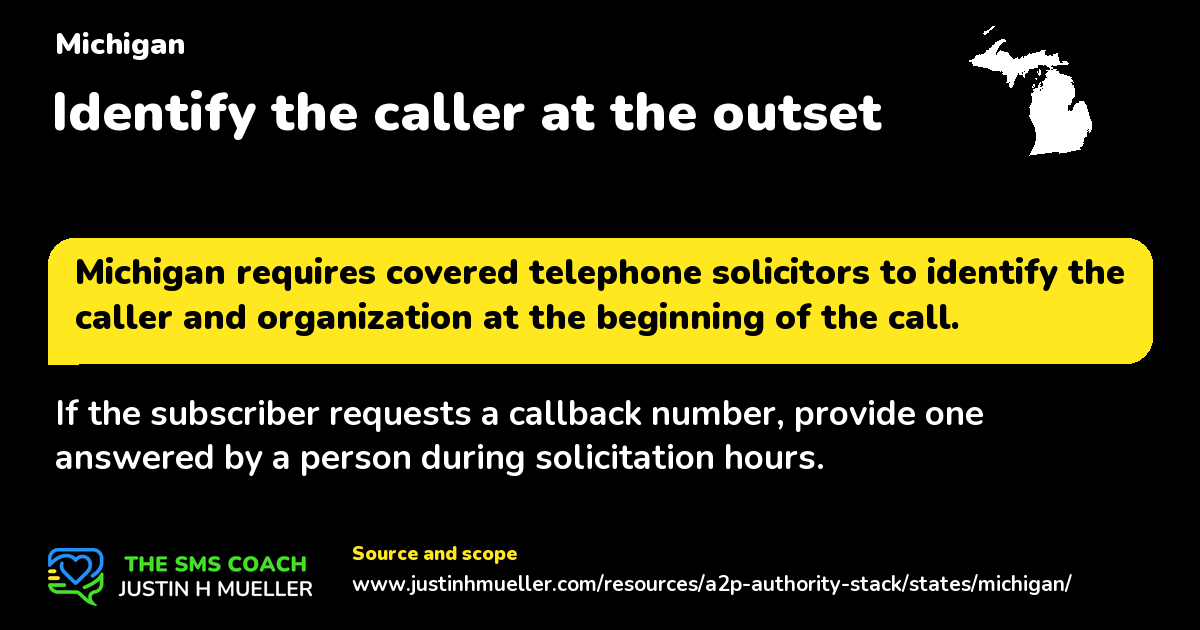
Identify the caller at the outset
Michigan requires covered telephone solicitors to identify the caller and organization at the beginning of the call.
What to check. If the subscriber requests a callback number, provide one answered by a person during solicitation hours.
What the sources say
The Michigan source records on this page do not expressly establish a general SMS or MMS rule. They are included because related telemarketing, do-not-call, privacy, or consumer-protection requirements may still matter to a messaging program.
Authorities and official sources
Each entry explains what the source says, where its limits are, and what it does not establish.
How source verification and review dates are documented
State law · Current
MCL § 445.111a
Release evidence review · 2026-11-19
The previously unconfirmed citations were checked against the primary sources below on November 19, 2026. Each citation identifies the point it supports.
Historical source and review record
Recorded source support: Supported. Historical verification disposition: Unresolved. Current substantive review: Pending; citation pinpoints checked. Recorded review date: 2026-10-19.
Justia2025 sections445.111(m),111a(1),(4)-(7),111c(1)-(3),111e; Michigan AG named headings; LegiScan current status; SFA May28 analysis; Moss January29 release. Secondary reproduction/trackers are identified and not represented as official 2026 code. Official consolidated and111b access gaps remain. Public-claim reconciliation completed with stated limitations.
How this authority relates to messaging
This source is relevant to the broader program, but the recorded text does not expressly establish general SMS or MMS coverage.
What the source establishes
- Michigan’s Home Solicitation Sales Act restricts covered recorded-message solicitations and calls to listed residential subscribers. At the start of a covered telephone solicitation, the caller must identify the caller and organization. On request, the caller must provide a telephone number answered by a person during solicitation hours. Other provisions address deceptive conduct and direct objections.
- The Michigan Senate passed SB 351–355 on January 29, 2026 and sent them to the House. LegiScan’s status/history viewed October 19, 2026 lists SB 351 as engrossed, pending in the House Regulatory Reform Committee after referral on February 3, 2026; its related-bill entries list the same referral for SB 352–355. The Senate Fiscal Agency analysis dated May 28, 2026 describes the package as proposed legislation passed by the Senate.
Limits and important context
- Section 445.111(m), in the 2025 reproduction, defines telephone solicitation as voice communication and excludes prior express invitation or permission, qualifying existing-customer calls unless the customer objected, and specified requests for a face-to-face meeting without a purchase decision during the call. Section 445.111e excludes persons subject to the listed charitable/public-safety solicitation acts or Internal Revenue Code section 527. These provision-specific limits are not a finding that no federal, state consumer-protection or other law applies to texts.
- The Attorney General identifies the state 9 p.m.–9 a.m. unsolicited-commercial-call restriction under MCL 750.540e(f), separately from the federal 9 p.m.–8 a.m. restriction summarized on its page.
- Section 445.111c(3), in the 2025 reproduction and corroborating AG guidance, provides a person suffering loss actual damages or $250, whichever is greater, plus reasonable attorney fees. Section 445.111c(2) expressly excludes failures to comply with section 1a(1), (4), (5), or section 1b from its misdemeanor provision.
- MCL 445.111a and 445.111b establish the recorded-message, do-not-call and identification duties described here. The proposed text-message provisions are discussed separately in the dated legislative history.
Official and supporting sources
- Michigan Legislature, MCL 445.111a(1)–(4) The recorded-message prohibition and the bar on covered calls to listed residential subscribers are separate provisions.
- Substantive guidance after navigation; state and federal curfews distinguished Source retrieved through a second public access path.
- Justia 2025 statutory reproduction: 445.111(j)-(n), especially voice-communication definition and exclusions; not an official publisher Source retrieved through a second public access path.
- Justia 2025 statutory reproduction: 445.111a(1),(4)-(7); history: 2002 PA 612 effective March 31, 2003 Source retrieved through a second public access path.
- Michigan Legislature, MCL 445.111b(1) The caller must identify the caller and organization at the outset. The organization’s telephone number must be provided on request and answered by a person during solicitation hours.
- Justia 2025 statutory reproduction: 445.111c(1)-(3), conduct, remedies and criminal-penalty exclusions Source retrieved through a second public access path.
- Justia 2025 statutory reproduction: 445.111e(a)-(c), exemptions for specified regulated persons Source retrieved through a second public access path.
- LegiScan status/history read October 19, 2026: engrossed January 29; House Regulatory Reform referral February 3; related SB 352–355 also listed as referred; secondary legislative tracker Source retrieved through a second public access path.
- Senate Fiscal Agency analysis, dated May 28, 2026, reproduced by LegiScan: pages 1–2 and 4; proposals as passed by Senate, not enacted law Source retrieved through a second public access path.
- Senator Moss official January 29, 2026 release: opening passage and closing statement that SB 351–355 were sent to House for further consideration Source retrieved for this release.
Source details
- Recorded source support
- Supported
- Historical verification disposition
- Unresolved
- Current substantive review
- Pending; citation pinpoints checked
- Recorded review date
- 2026-10-19
- Jurisdiction
- Michigan
- Source type
- State law
- Recorded operative status
- Current
Continue with the most useful next step
Move from a jurisdiction or authority layer to the sources and tools most likely to answer the next question.
A2P Compliance Audit
Explore a scoped review of consent, disclosures, registration, and governance.