Oregon SMS Marketing and A2P Messaging Rules
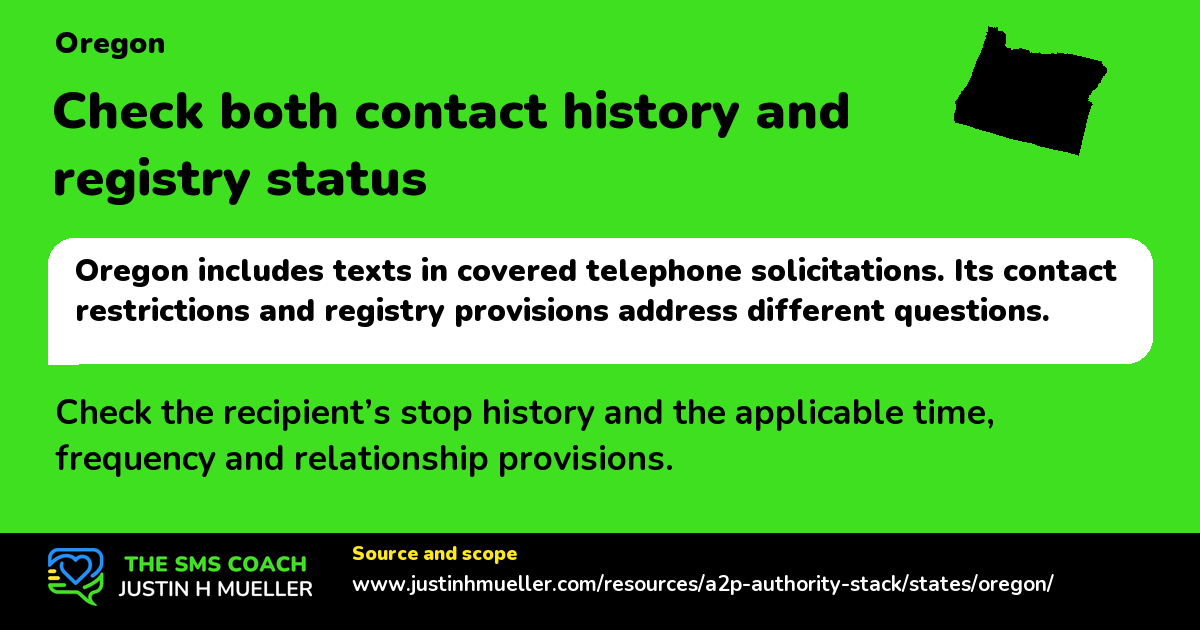
Solicitation timing and frequency. Check the recipient’s stop history and the applicable time, frequency and relationship provisions.
Check both contact history and registry status
Oregon includes texts in covered telephone solicitations. Its contact restrictions and registry provisions address different questions.
What to check. Check the recipient’s stop history and the applicable time, frequency and relationship provisions.
What the sources say
The Oregon source records on this page include 1 source with express text-message coverage. Other sources may apply only to particular activities or provide related context. Federal law, carrier policy, and sender-registration requirements may still apply alongside state law.
Authorities and official sources
Each entry explains what the source says, where its limits are, and what it does not establish.
How source verification and review dates are documented
State law · Current
ORS 646.561, 646.563, 646.567, 646.569, as amended by 2025 c.580
Release evidence review · 2026-11-19
The previously unconfirmed citations were checked against the primary sources below on November 19, 2026. Each citation identifies the point it supports. Some passages were available through an indexed copy of the publisher’s text.
Historical source and review record
Recorded source support: Supported. Historical verification disposition: Verified. Current substantive review: Pending; citation pinpoints checked. Recorded review date: 2026-10-19.
Bounded correction using the cited passage. Existing sound research retained; no blanket absence-of-law or exhaustive-jurisdiction conclusion. Public-claim reconciliation completed with stated limitations.
How this authority relates to messaging
The recorded source expressly includes text messaging within a broader legal or regulatory framework.
What the source establishes
- Oregon ORS646.561 expressly includes text messages in covered telephone solicitations. Section646.563 addresses stop requests, hours/frequency and truthful identity/purpose; sections646.567-.569 separately govern defined DNC solicitations.
Limits and important context
- Section646.563(1)(b) prohibits solicitation outside8 a.m.-8 p.m. or more than three times within24 hours and places an established-business-relationship qualification after that combined clause. Section(1)(a) separately prohibits subsequent solicitation after a called or texted party's stop request.
- Section646.561(4)(b) excludes specified charity/public-agency messages to members, donors or persons expressing donation interest; limited polling/ideas/opinions/votes; B2B communications; and direct responses to a party's message. The separate DNC definitions and exceptions must be read in their own scope.
Exceptions or special treatment
- The communication meets646.561(4)(b) or the specific qualification in646.563(1)(b); DNC exceptions have separate scope.: Summary, not a quotation: Section646.561(4)(b) lists the qualified charity/public-agency, polling, B2B and direct-response exclusions. Section646.563(1)(b) places an established-business-relationship qualification after its combined hours/frequency restriction.
Official and supporting sources
- Oregon Legislature, ORS 646.561, .563, .567 and .569 Text messages fall within the defined solicitation rules. Section .563 covers stop requests, timing, frequency and identity. The do-not-call provisions have their own definition. Reviewed in the search index’s copy of the publisher’s text.
- ORS 646.561 and 646.563, solicitation definitions and restrictions Source retrieved through a second public access path.
Source details
- Recorded source support
- Supported
- Historical verification disposition
- Verified
- Current substantive review
- Pending; citation pinpoints checked
- Recorded review date
- 2026-10-19
- Jurisdiction
- Oregon
- Source type
- State law
- Recorded operative status
- Current
State law · Current
Oregon Consumer Privacy Act
Release evidence review · 2026-11-19
The previously unconfirmed citations were checked against the primary sources below on November 19, 2026. Each citation identifies the point it supports.
Historical source and review record
Recorded source support: Supported. Historical verification disposition: Verified with correction. Current substantive review: Pending; citation pinpoints checked. Recorded review date: 2026-10-19.
Passage locator: ORS646A.570-.589; .572 scope/exclusions; .574 rights; .578(1)-(5); .586 assessments; .589 and 2025 ch.417 sections5-6; DOJ current business FAQs; 2026 A&R table p.4. Routing is authority discovery; the legal-review condition preserves thresholds and exemptions not represented by the input form. This record does not determine permission to send messages.
How this authority relates to messaging
This source is relevant to the broader program, but the recorded text does not expressly establish general SMS or MMS coverage.
What the source establishes
- Oregon's Consumer Privacy Act generally covers businesses or providers serving Oregon residents that process at least 100,000 consumers' personal data, excluding payment-only processing, or at least 25,000 consumers while deriving at least 25% of annual gross revenue from data sales. Motor-vehicle manufacturers and affiliates processing vehicle-use personal data are subject without those numerical thresholds, subject to statutory exemptions.
- Covered consumers have access, correction, deletion, portability and specified opt-out rights. Current requirements include qualifying universal opt-out signals, sensitive-data consent, privacy notices, reasonable safeguards and data-protection assessments. Consent revocation must be at least as easy as consent and honored as soon as practicable, within fifteen days.
- Since January 1, 2026, the law bans sale of precise geolocation data as defined and, with actual-knowledge or wilful-disregard conditions, sale of under-16 consumers' personal data and targeted advertising or significant-effect profiling of those consumers.
Limits and important context
- Exemptions distinguish entities, data and activities; there is no general exemption for every nonprofit or every HIPAA-covered entity's data. Communications content and specified utility-metering data are excluded from the geolocation-sale restriction. Commercial and employment contexts and specified health, financial, insurance and journalistic processing require separate analysis.
- The Attorney General exclusively enforces the Act and may seek up to $7,500 per violation; no private action is created. The general mandatory cure opportunity ended January 1, 2026, and the special noncommercial-broadcaster extension was repealed July 1, 2026. Privacy-law consent does not substitute for applicable messaging permission.
Facts that may change the result
- Do the organization's processing, state nexus and applicable scope tests fall within Oregon Consumer Privacy Act, after the stated entity and data exemptions?
Official and supporting sources
- ORS646A.570-.589 and following 2025 ch.417 cure-period notes Source retrieved through a second public access path.
- Current DOJ business FAQs: commencement and January 2026 requirements Source retrieved for this release.
- Oregon Legislature, 2026 regular-session amended and repealed sections table, printed page 4 In the ordered table, 646A.115 is followed by 646A.694. No section in 646A.570–.589 is listed. This finding is limited to this table and session.
Source details
- Recorded source support
- Supported
- Historical verification disposition
- Verified with correction
- Current substantive review
- Pending; citation pinpoints checked
- Recorded review date
- 2026-10-19
- Jurisdiction
- Oregon
- Source type
- State law
- Recorded operative status
- Current
Continue with the most useful next step
Move from a jurisdiction or authority layer to the sources and tools most likely to answer the next question.
A2P Compliance Audit
Explore a scoped review of consent, disclosures, registration, and governance.