Tennessee SMS Marketing and A2P Messaging Rules
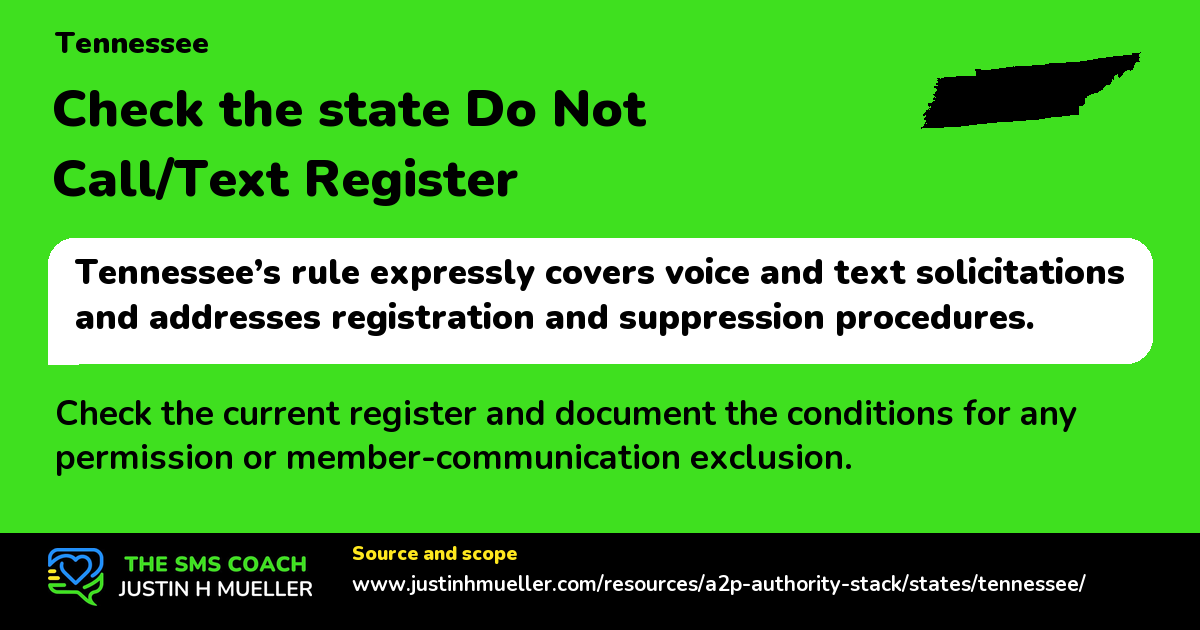
Do Not Call/Text Register. Check the current register and document the conditions for any permission or member-communication exclusion.
Check the state Do Not Call/Text Register
Tennessee’s rule expressly covers voice and text solicitations and addresses registration and suppression procedures.
What to check. Check the current register and document the conditions for any permission or member-communication exclusion.
What the sources say
The Tennessee source records on this page include 1 source with express text-message coverage. Other sources may apply only to particular activities or provide related context. Federal law, carrier policy, and sender-registration requirements may still apply alongside state law.
Authorities and official sources
Each entry explains what the source says, where its limits are, and what it does not establish.
How source verification and review dates are documented
Official agency guidance · Current
Tennessee Do Not Call Program
Release evidence review · 2026-11-19
The previously unconfirmed citations were checked against the primary sources below on November 19, 2026. Each citation identifies the point it supports. Some passages were available through an indexed copy of the publisher’s text.
Historical source and review record
Recorded source support: Supported. Historical verification disposition: Verified. Current substantive review: Pending; citation pinpoints checked. Recorded review date: 2026-10-19.
Passage locator: Current rule directory and Rule 1220-04-11-.01 through -.08, pages 1–7, including administrative histories. Current review applies to the revised public assertions and mapped applicability, with the stated qualifications. Historical source_claims and classifications remain provenance.
How this authority relates to messaging
The recorded source expressly applies to a particular type of text message or a specific messaging issue.
What the source establishes
- Tennessee Rule 1220-04-11 expressly covers voice and text solicitations. The current Secretary of State directory links the amendments filed July 9, 2024 and effective October 7, 2024. Covered solicitors must register, maintain suppression procedures and use the current Do Not Call/Text Register.
Limits and important context
- The definition excludes prior express permission, bona fide member communications for qualifying tax-exempt organizations, customers with a business relationship in the preceding twelve months, and occasional isolated communications satisfying every listed condition. Business telephone subscribers cannot join the Register.
- Covered residential calls/texts outside 8 a.m.–9 p.m. recipient local time require prior express permission. Identification and callback duties apply; the twenty-five-second automated disclosure provision specifically addresses voice calls.
- The Register updates monthly; consumer enrollment becomes effective thirty days after the first day of the next month. Rule .07 permits penalties up to $2,000 per violation payable to the Commission and further court relief, with a reasonable-practices-and-procedures defense. This is not an assertion of a private $2,000 text-message remedy.
Official and supporting sources
- Tennessee Public Utility Commission, Do Not Call/Text consumer FAQs The Commission describes registration of telephone numbers and complaints about covered solicitation calls and texts. Reviewed in the search index’s copy of the publisher’s text.
- Tennessee Secretary of State, filing 07-07-24, Rule 1220-04-11 The filing and the rule history identify the July 9, 2024 filing and October 7, 2024 effective date. Reviewed in the search index’s copy of the publisher’s text.
- Tennessee Secretary of State, Rule 1220-04-11-.01 through -.05 and -.08 The rules define covered communications and prescribe registration, use of the register, suppression procedures and enforcement. Reviewed in the search index’s copy of the publisher’s text.
- Tennessee Public Utility Commission, Do Not Call/Text resources Source retrieved through a second public access path.
Source details
- Recorded source support
- Supported
- Historical verification disposition
- Verified
- Current substantive review
- Pending; citation pinpoints checked
- Recorded review date
- 2026-10-19
- Jurisdiction
- Tennessee
- Source type
- Official agency guidance
- Recorded operative status
- Current
State law · Current
Tennessee Information Protection Act
Release evidence review · 2026-11-19
The previously unconfirmed citations were checked against the primary sources below on November 19, 2026. Each citation identifies the point it supports. Some passages were available through an indexed copy of the publisher’s text.
Historical source and review record
Recorded source support: Supported. Historical verification disposition: Verified with correction. Current substantive review: Pending; citation pinpoints checked. Recorded review date: 2026-10-19.
Passage locator: 2023 PublicChapter408 section2 scope, rights, duties, exemptions, enforcement and affirmative defense; section6 commencement; 2025 PC201 sections1-2;2026 PC614 sections9,11; AG2025 TIPA guide. Routing is authority discovery; the legal-review condition preserves thresholds and exemptions not represented by the input form. This record does not determine permission to send messages.
How this authority relates to messaging
This source is relevant to the broader program, but the recorded text does not expressly establish general SMS or MMS coverage.
What the source establishes
- The Tennessee Information Protection Act took effect July 1, 2025. Its scope requires more than $25 million in revenue plus either processing at least 175,000 consumers' personal information during a calendar year, or at least 25,000 consumers while deriving more than 50% of gross revenue from personal-information sales, within the Act's Tennessee business/targeting scope.
- Covered consumers have access, correction, deletion, portability and sale, targeted-advertising and significant-effect-profiling opt-out rights. Controllers must provide privacy notices, required sensitive-data consent and reasonable safeguards; processor contracts and assessments apply to specified processing.
- Public Chapter 201 of 2025 expanded the nonprofit definition's public-utility clause to utilities organized or regulated under Tennessee law, effective July 1, 2025. Public Chapter 614 removed the exclusion for data generated from photographs or video/audio recordings from the biometric-data definition, effective July 1, 2026; it did not remove the separate exclusion for the photographs and recordings themselves.
Limits and important context
- The Act excludes specified government, financial, insurance, HIPAA, nonprofit, higher-education, employment and regulated-data contexts. The 2023 enrolled Act used proposed part32 numbering; subsequent enactments identify the codified definitions as section47-18-3302. It is a privacy overlay rather than independent texting permission.
- The Attorney General exclusively enforces the Act, subject to 60-day notice and a cure/written-assurance process. Civil penalties may reach $7,500 per violation; courts may award treble damages for wilful or knowing violations, and the Act creates no private action. A qualifying maintained written privacy program can supply the statutory affirmative defense; a NIST label alone is insufficient. Assessment obligations cover processing created or generated on or after July 1, 2024, although the Act commenced July 1, 2025.
Facts that may change the result
- Do the organization's processing, state nexus and applicable scope tests fall within Tennessee Information Protection Act, after the stated entity and data exemptions?
Official and supporting sources
- Tennessee Secretary of State, Public Chapter 408 (2023), §§ 2 and 6 The enacted Act sets the revenue and processing thresholds, controller obligations and July 1, 2025 commencement. The numbering in the session law differs from the code. Reviewed in the search index’s copy of the publisher’s text.
- Tennessee General Assembly, HB0911, Public Chapter 201 (2025) The enacted summary expands the nonprofit definition’s utility clause to a utility organized or regulated under Tennessee law. The recorded effective date is July 1, 2025. The enacted outcome and date were confirmed in the legislature’s bill record. The original chapter PDF was unavailable for an independent section-number check.
- Tennessee General Assembly, SB1735, Public Chapter 614 (2026), bill history and summary The legislature identifies chapter 614 and explains that the exclusion for data generated from a photograph or recording was removed July 1, 2026. The underlying photo or recording is separately addressed. The enacted outcome and date were confirmed in the legislature’s bill record. The original chapter PDF was unavailable for an independent section-number check.
- AG TIPA guide; commencement and assessment lookback Source retrieved through a second public access path.
Source details
- Recorded source support
- Supported
- Historical verification disposition
- Verified with correction
- Current substantive review
- Pending; citation pinpoints checked
- Recorded review date
- 2026-10-19
- Jurisdiction
- Tennessee
- Source type
- State law
- Recorded operative status
- Current
Continue with the most useful next step
Move from a jurisdiction or authority layer to the sources and tools most likely to answer the next question.
A2P Compliance Audit
Explore a scoped review of consent, disclosures, registration, and governance.